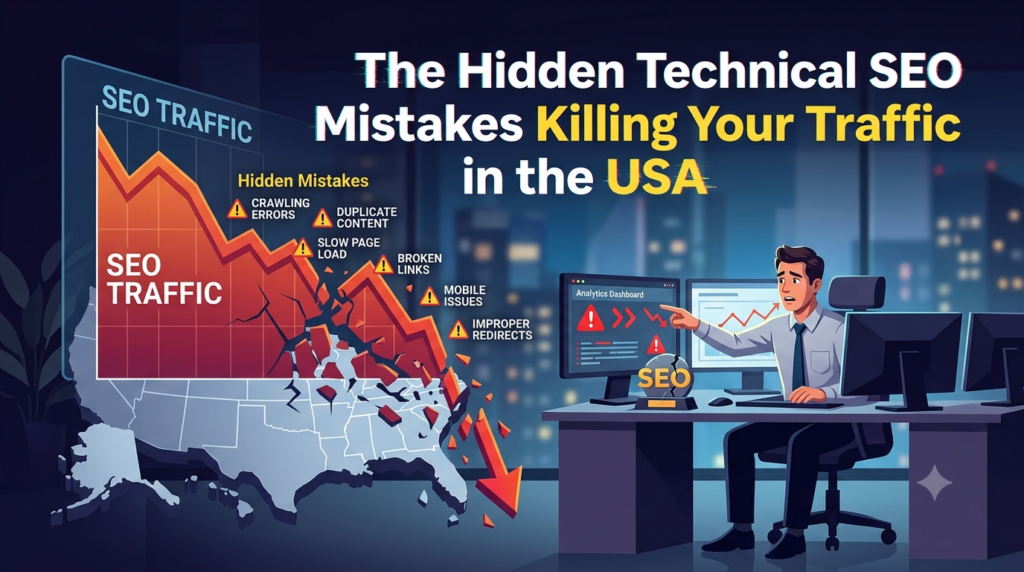
Why Your Website Traffic Is Dropping (And It Might Not Be Your Content)
A sudden drop in website traffic can feel frustrating, especially when you’ve already invested time into creating quality content. Most people immediately blame poor writing, weak keywords, or tough competition.
But what if the real issue isn’t what users see… but what’s happening behind the scenes?
Technical SEO is often overlooked, yet it directly impacts how search engines access, interpret, and rank your site. Even small technical flaws can quietly hold your website back.
Let’s explore some less obvious (still critical) technical SEO problems that could be affecting your performance.
Your Website Structure Is Confusing Search Engines
Think of your website like a map. If the structure is messy or disorganized, search engines struggle to understand which pages matter most.
When pages are buried too deep, lack clear hierarchy, or aren’t connected properly, they may never gain visibility. A clean structure with logical categories and smart navigation helps search engines prioritise and rank your content effectively.
You’re Wasting Your Crawl Budget
Search engines don’t crawl your entire site endlessly, they allocate a limited “crawl budget.” If that budget is wasted on unnecessary pages, your important content might be ignored.
Pages like filters, duplicate URLs, or outdated content can eat up this budget. Optimising what should (and shouldn’t) be crawled ensures search engines focus on pages that actually matter.
JavaScript Is Blocking Important Content
Modern websites rely heavily on JavaScript, but here’s the issue, not all search engines process it perfectly.
If key content or links depend on JavaScript to load, there’s a chance search engines won’t fully see or index them. This can lead to incomplete indexing and lower rankings, even if your content is valuable.
Ensuring critical elements are accessible without heavy reliance on scripts can make a big difference.
Your Metadata Isn’t Optimised
Title tags and meta descriptions might seem small, but they play a huge role in how your site performs in search results.
Missing, duplicated, or poorly written metadata can confuse search engines and reduce click-through rates. Every page should have unique, clear, and relevant metadata that accurately reflects its content.
You’re Ignoring Core Web Vitals
Search engines now consider user experience signals like loading performance, visual stability, and interactivity.
If your site shifts while loading, responds slowly to clicks, or takes too long to become usable, it creates a poor experience, and rankings can suffer as a result.
Improving these metrics isn’t just about SEO as it directly impacts how users interact with your site.
Orphan Pages Are Killing Your Visibility
Orphan pages are pages with no internal links pointing to them. Even if they exist on your site, search engines may struggle to find them.
This means valuable content can go completely unnoticed. Connecting these pages through proper internal linking ensures they’re discovered, indexed, and ranked.
International or Local Targeting Is Misconfigured
If your website targets users in the U.S. (or multiple regions), incorrect geo-targeting settings can hurt visibility.
Issues like missing hreflang tags or unclear location signals can confuse search engines about who your content is meant for. This can result in your site appearing in the wrong regions, or not appearing at all where it matters most.
Redirect Issues Are Slowing Everything Down
Redirects are useful, but too many of them, or poorly implemented ones can create problems.
Redirect chains (multiple redirects in a row) slow down page loading and dilute SEO value. Cleaning up unnecessary redirects and ensuring direct paths improves both speed and ranking efficiency.
Final Thoughts
Technical SEO isn’t something users notice, but search engines definitely do.
You can publish amazing content every week, but if your technical foundation is weak, your growth will always be limited. The key is to treat technical SEO as an ongoing process, not a one-time fix. Because there are so many things that keep the website running, visible in search results, enhance user experience, and some of these things are what technical SEO is all about.
By identifying and resolving these hidden issues, you give your website such as Coding On The Rocks a much stronger chance to perform, rank, and grow, especially in a competitive market like the U.S.